
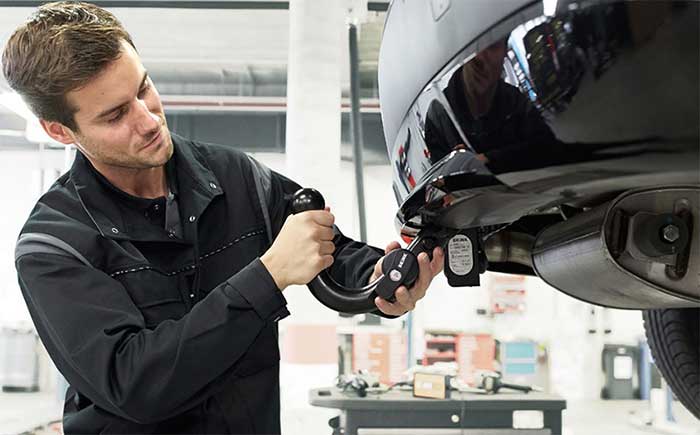
Category: Industry News | Compliance | Towbar Fitting
Introduction: Why SERMI Matters to Towbar Fitters
The UK automotive aftermarket is undergoing one of its most significant regulatory shifts in decades with the introduction of SERMI — the Security-related Vehicle Repair and Maintenance Information scheme. While SERMI has been discussed primarily in the context of independent garages and vehicle security specialists, its impact extends directly to towbar fitters, especially those working on modern vehicles, vans, EVs, and hybrids.
As vehicles become increasingly software-controlled, even traditionally “mechanical” modifications such as towbar fitting now involve interaction with vehicle security systems, ECUs, and manufacturer-controlled data. SERMI is changing how towbar fitters access this information — and who is authorised to do so.
What Is SERMI?
SERMI (Security-related Vehicle Repair and Maintenance Information) is a European-wide authorisation scheme designed to allow approved independent operators to access security-related vehicle data on the same basis as franchised dealerships.
SERMI is managed jointly by vehicle manufacturers, represented by ACEA (European Automobile Manufacturers’ Association), and independent operators. In the UK, the rollout has been supported by the Independent Garage Association (IGA), with scheme administration handled by RMISC.
SERMI approval enables authorised technicians to access security-related Repair and Maintenance Information (RMI), including:
- Immobiliser and key programming data
- Security gateway access
- Vehicle configuration and coding permissions
From 1 April 2026, SERMI officially goes live in the UK.
Why Towbar Fitters Are Directly Affected
Historically, towbar fitting was seen as a mechanical installation supported by basic electrics. That is no longer the case.
On modern vehicles, particularly:
- CAN-bus equipped cars
- Vans with body control modules
- EVs and hybrids with advanced driver assistance systems (ADAS)
towbar installation often requires:
- Vehicle coding to enable towing mode
- Trailer Stability Programme (TSP) activation
- Integration with parking sensors, blind-spot monitoring, and emergency braking systems
- Access through manufacturer security gateways
Without SERMI authorisation, access to this security-related data may be restricted or blocked altogether.
Manufacturers Supporting SERMI
Following the UK go-live announcement, manufacturer support has been rapid. Brands already committed to SERMI access include:
Abarth, Alfa Romeo, Chrysler, Citroën, Dodge, DS Automobiles, Fiat, Ford, Jaguar, Jeep, Land Rover, Lancia, Maserati, Nissan, Opel, Peugeot, RAM, Toyota, and Vauxhall.
For towbar fitters, this is critical. These manufacturers increasingly require authenticated access for coding and configuration tasks that were previously unrestricted.
What Happens Without SERMI Approval?
Towbar fitters operating without SERMI authorisation may face:
- Inability to complete coding on certain vehicles
- Reliance on third parties or franchised dealers
- Increased job time and reduced margins
- Compliance risks where systems are bypassed
More importantly, incorrect or incomplete coding can affect:
- Trailer lighting logic
- Stability control systems
- Emergency braking behaviour
- EV energy management while towing
This creates both safety and liability concerns for installers.
SERMI and Duty of Care
From a legal and compliance standpoint, SERMI reinforces an existing principle: If your work affects vehicle safety or security, you must be competent, authorised, and compliant.
Towbar fitters working on vehicles requiring security access are increasingly expected to demonstrate:
- Authorised access to manufacturer systems
- Technician identity verification
- Secure handling of vehicle data
SERMI provides a standardised, auditable framework to meet these expectations.
What Towbar Fitters Should Be Doing Now
With SERMI now live in the UK, towbar fitting businesses should take proactive steps:
- Assess Your Vehicle Coverage
Identify which manufacturers and vehicle types you regularly work on that require security access. - Understand Your Access Requirements
If you code vehicles, enable towing functions, or interact with security gateways, SERMI is likely required. - Prepare Documentation
SERMI approval requires business verification, technician identity checks, and compliance documentation. - Upskill Technicians
Training in modern towbar integration, EV towing systems, and vehicle electronics is becoming essential.
Where Training Fits In
As the technical and regulatory landscape evolves, professional training providers such as Towing Solutions can support towbar fitters by building competence and confidence around modern towing integration.
Industry-aligned training helps ensure:
- Correct towbar installation on modern vehicles
- Understanding of vehicle systems affected by towing
- Improved compliance and reduced risk of faults
- Better outcomes for fleets and end customers
SERMI access enables the data — training ensures it is used correctly.
SERMI Is Not Optional for the Future
SERMI is not about creating barriers for independent businesses. It exists to ensure secure, traceable, and professional access to vehicle systems in an era where security and safety are inseparable.
For UK towbar fitters, SERMI represents:
- A shift from informal access to regulated authorisation
- An opportunity to professionalise and future-proof services
- A clear signal that towing integration is now a technical discipline, not just a mechanical one
Those who adapt early will be best placed to continue working across all vehicle types — including EVs, hybrids, and advanced commercial fleets.