
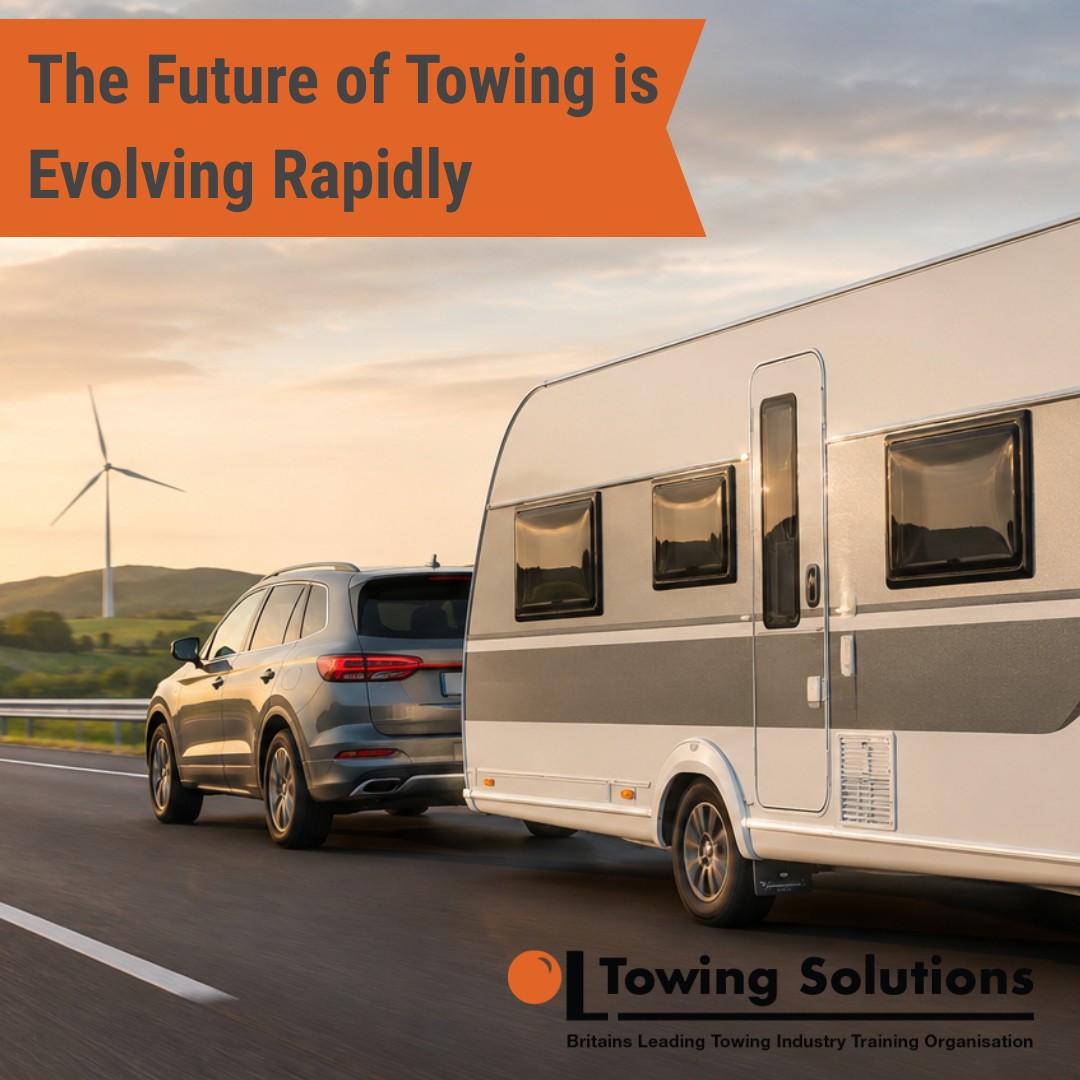
The automotive industry is changing faster than ever before. Electric vehicles, hybrid vans, automated driving systems and advanced driver assistance technology are becoming increasingly common across UK roads.For drivers towing caravans, trailers, horseboxes and commercial equipment, these technological changes bring both opportunities and new challenges. While many modern vehicles now feature intelligent safety systems and semi-automated driving technology, towing still requires skill, awareness and driver understanding.At Towing Solutions, we are seeing increasing numbers of modern vehicles arriving on towing and trailer training courses equipped with advanced driver assistance systems (ADAS), regenerative braking systems and towing-related technology. Many drivers are unaware of how these systems behave differently when towing.
Understanding these developments is becoming essential for caravan owners, fleet operators, trailer users and businesses operating towing vehicles.
1. Advanced Driver Assistance Systems (ADAS) Are Now Common on Tow Vehicles
Many new vehicles now include advanced driver assistance systems designed to improve road safety and reduce driver workload. These systems include:
- Adaptive cruise control
- Lane keeping assist
- Autonomous emergency braking (AEB)
- Blind spot monitoring
- Trailer stability assist
- Parking and reversing technology
While these systems can improve safety, towing changes how vehicles behave. Trailer weight, load distribution and towing dynamics can affect braking distances, steering response and vehicle sensors.
Many drivers wrongly assume these systems remove the need for towing experience or towing training. In reality, drivers still need to understand how their vehicle behaves when towing a caravan or trailer.
Incorrect use of automated systems while towing can increase risk rather than reduce it.
2. Semi-Automated Driving Technology Is Already on UK Roads
Fully self-driving vehicles are not yet available to the public in the UK. However, Level 2 automated driving systems are already becoming more common.
Systems such as Ford BlueCruise allow limited hands-free driving on approved motorway sections, provided the driver remains alert and ready to take control at all times.
According to the UK government and vehicle manufacturers, drivers remain legally responsible for the vehicle even when assistance systems are active.
Official GOV.UK guidance on self-driving vehicles and automated vehicle technology can be found here:
https://www.gov.uk/government/collections/self-driving-vehicles-guidance-for-motorists
For towing drivers, this creates additional considerations. Automated systems may react differently when a trailer or caravan is attached, particularly during:
- Lane positioning
- Emergency braking events
- Motorway driving
- Crosswind conditions
- Trailer instability situations
Drivers must remain fully engaged and understand the limitations of vehicle technology while towing.
3. Electric Vehicles Are Changing Towing Behaviour
The rapid growth of electric vehicles and hybrid vans is transforming towing across the UK.
Unlike traditional diesel vehicles, EVs behave very differently when towing due to:
- Instant torque delivery
- Regenerative braking systems
- Heavy battery weight
- Reduced towing range
- Advanced energy management systems
Many fleet operators and caravan owners are now discovering that towing with electric vehicles requires a different driving approach.
Drivers often underestimate how significantly towing can reduce battery range, particularly at motorway speeds or in cold weather.
Charging infrastructure can also create practical challenges for caravan and trailer users, especially where charging bays do not easily accommodate trailers.
At Towing Solutions, our Electric Vehicle & Hybrid Van Driver Training Course helps drivers understand how EV technology affects towing, braking, charging and vehicle handling.
4. Modern Towbars and Trailer Systems Now Require Vehicle Coding
Modern vehicles are becoming increasingly software-controlled. Even fitting a towbar to many vehicles now involves advanced electronic integration and coding.
Towbar installers often need to interact with:
- CAN-bus electrical systems
- Trailer stability systems
- Parking sensor calibration
- Trailer mode activation
- Advanced driver assistance systems
This means towbar fitting is no longer purely mechanical. Technicians increasingly require knowledge of vehicle electronics, security systems and software integration.
The rise of schemes such as SERMI (Security-related Vehicle Repair and Maintenance Information) highlights how access to vehicle systems is becoming more controlled and regulated.
For businesses operating fleets or towing vehicles, using properly trained towbar fitters and technicians is becoming more important than ever.
5. Driver Training Is Becoming More Important — Not Less
One of the biggest misconceptions surrounding automation is that driver skill becomes less important. In reality, the opposite is true.
As vehicles become more advanced, drivers must understand:
- How automated systems work
- The limitations of driver assistance technology
- How towing affects vehicle behaviour
- How EVs and hybrids behave under load
- How to remain compliant with UK towing laws
Without proper training, drivers may become over-reliant on technology or misunderstand how systems behave in real-world towing situations.
Official UK towing guidance can be found here:
https://www.gov.uk/towing-with-car
Common Mistakes Drivers Make With Modern Tow Vehicles
As towing technology evolves, several common mistakes continue to appear:
- Assuming automated systems prevent trailer instability
- Overloading EV tow vehicles
- Ignoring towing range reductions
- Failing to understand regenerative braking behaviour
- Using incorrectly coded towbar systems
- Over-relying on parking and reversing technology
These issues highlight why towing safety checks and practical towing awareness remain essential.
Safety Considerations for Modern Towing Vehicles
Drivers towing with modern vehicles should always:
- Carry out pre-towing safety inspections
- Check trailer weight and load distribution
- Understand their vehicle’s towing limits
- Allow for increased stopping distances
- Understand how driver assistance systems behave when towing
- Monitor tyre condition and pressures carefully
Technology can assist drivers, but it cannot replace safe driving habits and towing awareness.
Why Professional Towing Training Matters
At Towing Solutions, we provide practical towing and trailer training designed around modern vehicle technology and real-world towing conditions.
Our caravan towing courses and trailer training programmes help drivers understand:
- Modern towing safety systems
- Trailer stability and load security
- EV and hybrid towing behaviour
- Safe towing techniques
- UK towing laws and compliance
Professional training helps reduce risk, improve confidence and prepare drivers for the future of towing technology.
The Future of Towing Is Evolving Rapidly
Automation, electrification and vehicle connectivity are transforming the automotive industry. While these developments bring exciting opportunities, they also increase the importance of driver understanding and towing competence.
Whether you operate caravans, commercial trailers, horseboxes or fleet vehicles, understanding how modern systems affect towing is becoming essential for safety, compliance and confidence.
To learn more about professional towing and EV driver training, visit:
https://towing-solutions.co.uk/course/caravan/